CPTSD (Complex Post Traumatic Stress Disorder) in Families of Veterans and First Responders

Updated: Jun 24
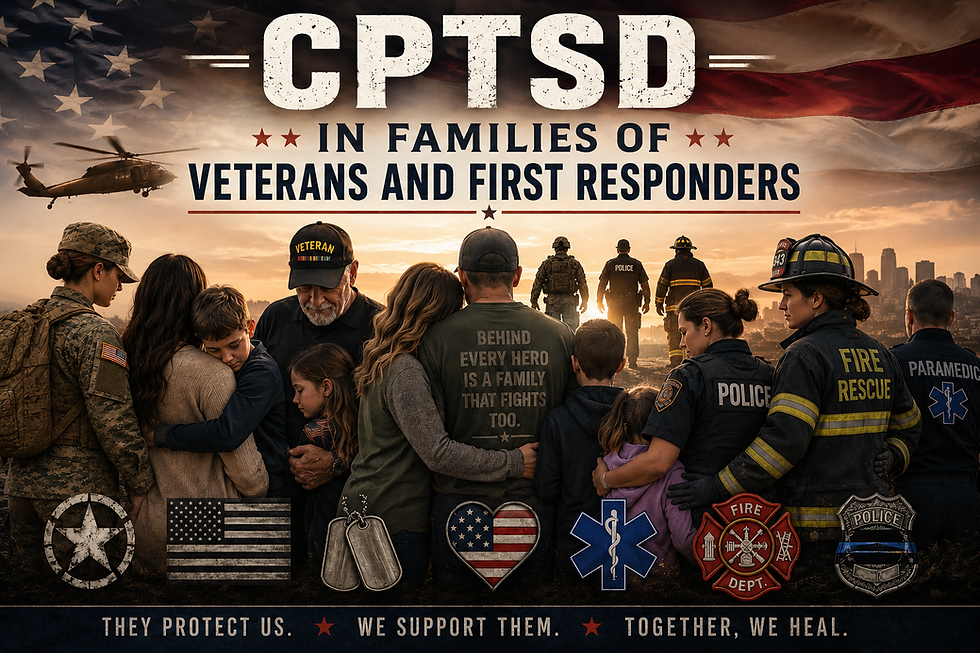
One of my favorite childhood memories was summer nights with my grandparents. My grandpa and I would take the dog for a walk to the original Dove Ice Cream shop. It was located at 60th and Pulaski, just a few blocks away from my grandparents’ house. Then we’d go home and watch M*A*S*H while eating our Dove bars. Those original Dove bars were so good! But the best part was watching M*A*S*H and seeing my grandpa laugh.
My grandpa loved that show because it brought some laughter to a traumatic time in his life. He was on the front lines of the Korean War, which was what the show was based on. There was never any talk about his time in the military; the only things he ever told me were that his best friend died in his arms, he lost the corner of the tip of his finger in a KP incident, and that war was stupid. I knew my grandpa had secrets and demons, but the only thing I cared about was how much he loved me and how safe he made me feel.
When my grandpa returned from the war, he became a police officer. By the time I was born, he was a Sergeant and Chief of Ballistics for the Chicago Police Department. I used to love sneaking into his office and looking at all his things. It smelled of pipe tobacco, which is still one of my favorite scents. He never minded that I went in there, but he did teach me about privacy and gun safety.
One area where I disrespected his privacy was the boxes of crime-scene photos he stored on the back porch. I didn’t know they were crime scene photos until I looked. That was pretty much a one-and-done situation for me. I wasn’t traumatized by the photos; I just didn’t want to look at them. I hated seeing people like that.
By this time in my life, my grandpa had more steady hours and was a stable presence in my life. That wasn’t the case for my mom, aunts, and uncles. Police schedules have changed over the years, so I don’t know what his was throughout his career, but by the time I was around 7 years old, my grandpa was primarily in the lab or the courthouse. Even after he retired, he spent quite a bit of time as an expert witness. Then again, when he retired from the Chicago Police Department, he began working for the Illinois State Police Department and helped open their crime lab. I don’t think my grandpa truly retired until he went into the hospital a month before he passed away.
I remember being in the hospital, sitting on his bed, talking to him just before things became really bad. It was a time when I was trying to figure out what I was going to do with my life. He and my mom already made it clear that I wasn’t to join the military, so I had begun testing for police departments, and I told him I was going to test for Chicago. His reaction was not what I expected. His eyes widened, and he shook his head no, rather sternly. He couldn’t talk at this point, but his face and body language told me everything I needed to know. I wish I could have asked him why he didn’t want me to be a police officer, but I never had the chance; he never regained his ability to talk and died shortly after that conversation. Though I did test for several departments and was on the list for many of them, I ultimately did not become a police officer. Part of me wonders if that was him working from the other side. It wouldn’t surprise me.
The police world didn’t end in my life when my grandpa passed. My stepdad, who was my primary caretaker along with my mom, was also a Chicago Police Officer. His career was impactful for me in a different way than my grandpa’s was. Grandpa wasn’t on the streets anymore, not even at crime scenes. My stepdad; he was on the streets. For most of my teen years, he was on the TAC team and worked midnights. It wasn’t until he retired after 29 years on the job that I realized how much his career impacted me.
Yes, he annoyed the crap out of me with how controlling he was, but I also knew it was because he loved me, knew what was happening on the streets, and he didn’t want me to be harmed. I remember when he joined the TAC team, our house became Fort Knox. We bought a Rottweiler for protection, which anyone who knew Bear would laugh at, since he was such a sweetheart. He did scare the sh*t out of people when he smiled, but he was also wagging his entire body while showing that smile. My mom slept with a police baton under the bed, and we had steel doors that you had to use a key to get in or out of the house. My stepdad also warned my mom and me that, as much as he would try to prevent work from coming home, there was always a chance of us being targeted because of what he did. Especially at that time, since the gangs were targeting homes and families of police officers as their initiation.
He did a good job at keeping work at work, but there were most definitely aspects that he couldn’t control. One of them was his temper. I’m very grateful his temper did not involve violence, but his mean mug and yell alone can be very scary. There were times I feared it would escalate, so I learned limits. The other aspects he had no control over were the fear of receiving a knock on the door in the middle of the night or the anxiety anytime there was “Breaking News” of a police-involved shooting, with no other details provided. You're always trying to find out the info. What district did it happen in? How many officers were involved? Was anyone fatally injured? Hoping that it wasn’t him or one of his team members.
Then there is the hypervigilance that is taught by how they live day to day. Sitting facing the door in any restaurant, checking for exits, scanning crowds for danger, head on a swivel, and analyzing every stranger for potential danger. I didn’t understand the depth of impact this had on me until I was completing my Master’s in Psychology, doing my own therapy, and working in treatment centers. It was when I started working with Veterans and hearing about my biological dad’s experience in the military that I really understood the depth of impact these careers have on children and families.
In the field of psychology, it is drilled into our brains that when working with couples and families, it is unethical for the therapist to keep secrets of one person from the other individuals within the sessions. When working with Veterans or active Military in particular, secrets are the norm. The higher their ranking and security clearance, the more secrets they keep. Obviously, this is important from a national security perspective; however, it can be highly detrimental from a trauma perspective.
The first time I saw someone killed in real life, I was 18 years old. I was working out at Bally’s Chicago Ridge and was on the staircase heading from the top floor to the main level when I heard what sounded like free weights being dropped on each other downstairs in the weight area. It wasn’t until the emergency exit alarm went off and I saw a man running out that I thought something was wrong. I ran down the stairs, and as soon as I turned the corner to run to the lower level, I saw a man lying in a pool of blood at the bottom of the stairs. I ran back to the main floor and told the front desk to call 911; someone had been shot. By the time the police and paramedics arrived, the man who was shot was dead, and the man who shot him was gone. The crime scene photos from my childhood became my reality in that moment. Later that evening, the news reported that the shooter had been caught, and it was a domestic situation. Even though I had this information, I was still anxious and hypervigilant for weeks after.
Imagine that being your normal for days, weeks, months, and sometimes years. Maybe it is a domestic situation, and the person is caught. Maybe it’s a war zone, and the enemy is still out there. Maybe it’s an innocent person caught in the middle of gang violence, and the neighborhood is too afraid to talk. For veterans, active military, and first responders, this is their normal. Even military and veterans who didn’t see active combat are trained to have this be their normal, and I don’t know any first responders who haven’t experienced something traumatic in their time on the job.
Throughout the years, they have been taught to compartmentalize and move on. Don’t bring it home. They may share stories of the good times. The crazy things they have done and the funny mishaps that occur. But you will rarely hear a first responder talk about the time they held the 16-year-old kid in their lap, putting pressure on the gunshot wound, impatiently waiting for the ambulance to show up while the kid bleeds out and takes his last breath. Or having to go to the kids’ house to report the news to their loved ones. They don’t share the details of the children they have to remove from the house after a domestic fight ended in homicide. Or the victims of sexual violence or molestation who will have lifelong wounds. Or the body found after the fire is put out. Or the family they couldn’t save in the car wreck. Those stories they don’t talk about. Those, they hold inside. That is the real-life experience of the men and women on the front lines in our cities and our country. That is the real-life experience of the husbands, wives, parents, grandparents, brothers, sisters, aunts, uncles, and cousins who show up every day in hopes of protecting innocent people. They do their best to leave it at work, but when work is protecting those in your community, city, and country, bringing it home is not an option. In one way or another, it will impact the whole family. Sometimes more than others.
The training has evolved over the years, and it is now encouraged to talk to a professional about traumatic events. In my experience, not many do this. Some training is harder to change. I've talked to a few about their hesitancy to speak with professionals, and they have very valid concerns. One of my concerns is that currently, the American Psychiatric Association does not acknowledge CPTSD as a diagnosis. According to the NIH, they currently diagnose those who have symptoms of CPTSD with PTSD and Borderline Personality Disorder. Why is this important? Because many of these men, women, and their families are 2nd, 3rd, and 4th generation military, veteran, and first responder families who, along with PTSD, also have CPTSD. Imagine being diagnosed with a personality disorder due to trauma you have experienced throughout your life. It doesn’t seem fair, does it? Then again, one thing my grandpa, dad, and stepdad have always taught me is that life isn’t fair. I guess they would know, wouldn’t they?


Comments